- What Needling Actually Is
- When Is Needling Used?
- The Engineering Behind a Needle Design
- Needling and Your Temporary Works Obligations
- Common Mistakes on Needling Operations
- What a Needle Design Pack Should Include
- Needling as Part of a Wider Propping and Support Strategy
- Needling Construction: Practical Checklist Before Work Starts
- FAQs
- Get the Design Right Before the Holes Are Cut
Needling is one of those temporary works techniques that site teams encounter regularly on refurbishment and alteration projects, yet it rarely gets a proper explanation before work starts. If you are managing a project that involves removing or modifying a load-bearing wall, inserting a new opening, or underpinning an existing structure, understanding how needling works — and when it is the right approach — could be the difference between a controlled operation and a structural failure.
This article covers the needling process from first principles, the scenarios where it applies, and the temporary works obligations that come with it.
What Needling Actually Is
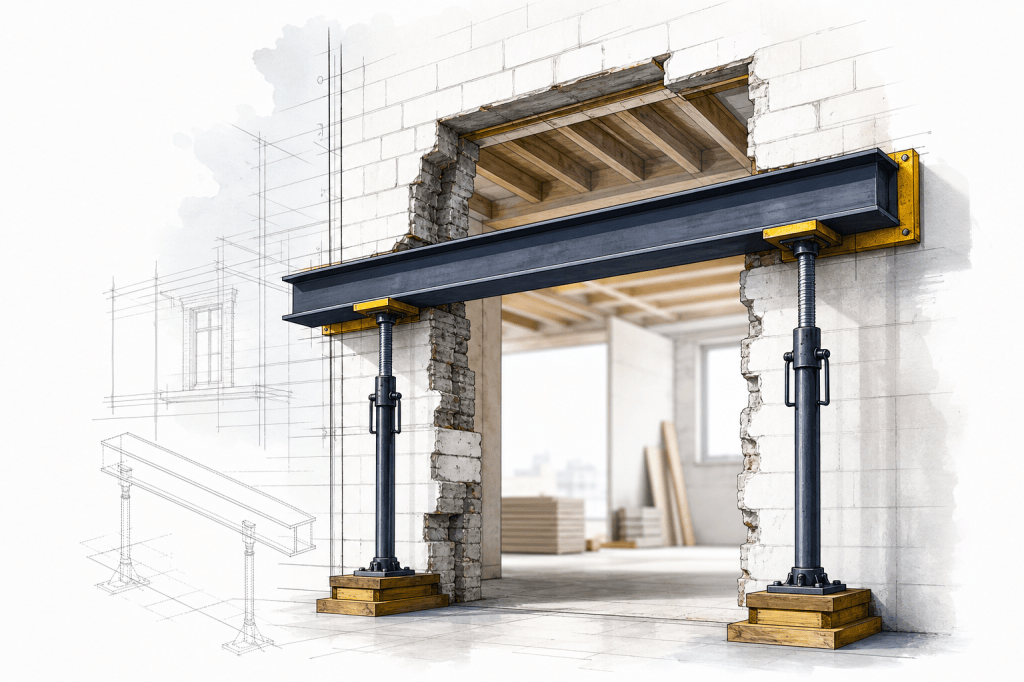
A needle is a temporary horizontal beam — or pair of beams — threaded through a wall or structural element to transfer the load it carries to temporary supports on either side. The wall is effectively picked up by the needle while work below it proceeds.
The name comes from the action itself: threading the beam through the structure, much like threading a needle. In practice, the beam passes through a hole cut in the wall and bears onto props, dead shores, or a grillage frame on each side. The load path runs from the structure above, down through the wall, into the needle, and then down through the props to the ground or a suitable bearing surface.
Needling almost always works in combination with other temporary works. The props carrying the needle loads need their own bearing design. The floor or ground beneath them must be assessed for the concentrated point loads they introduce. And the needle itself must be sized for the span and the load it is picking up.
When Is Needling Used?
Forming New Openings in Load-Bearing Walls
The most common application is creating a new door or window opening — or widening an existing one — in a load-bearing masonry or concrete wall. Before the opening can be formed, the load the wall is carrying must be transferred elsewhere. Needles provide that transfer path while the permanent lintel or beam is installed.
The sequence typically runs: cut the needle hole, install the needle and props, confirm the load has transferred, then form the opening below.
Underpinning Support
When a foundation needs underpinning, needles carry the wall load while the existing foundation is exposed and the new one is constructed beneath it. This is particularly common in basement and lower-ground-floor extensions where the new excavation undercuts existing footings.
Structural Alterations and Demolition Sequences
Partial demolition, floor insertions, and structural alterations in existing buildings often require sections of wall to be temporarily supported while the permanent structure is reconfigured. Needles allow work to proceed in a controlled sequence without destabilising what is above.
Bridging Over Weak Ground
On some projects, needles are used horizontally to bridge over a zone of weak or disturbed ground, distributing load to bearing points on either side. Less common than the wall-support applications, but the same engineering logic applies.
The Engineering Behind a Needle Design
A needle is not just a piece of steel pushed through a wall. A proper design considers several things.
Load assessment. The designer needs to establish what the needle is picking up: the wall load, any floor or roof loads the wall supports, and any eccentric loading effects. Getting this wrong is the most common source of problems.
Beam sizing. The needle must be sized to carry the assessed load across the span between props without exceeding allowable bending stress or deflection limits. Universal beams are the most common choice. Spans are typically short, but loads can be high in masonry buildings.
Prop and bearing design. Props must be checked for buckling under the applied load. The bearing surface beneath each prop must take the concentrated reaction without local failure. On upper floors, this often means a spreader arrangement to distribute load across multiple joists, or a grillage to spread it over a wider area.
Eccentricity and stability. A needle passing through a wall introduces eccentric loading unless the props are positioned symmetrically. Asymmetric arrangements need careful detailing to prevent the needle rotating or the props kicking out.
Hole size and masonry disturbance. The hole cut for the needle needs to be large enough to allow installation but small enough to limit disturbance to the masonry above. Oversized holes can cause local spalling or cracking before the needle is even loaded.
All of this must be captured in a formal temporary works design: calculations, a sketch or drawing showing the arrangement, and a design risk assessment. Under BS 5975:2024, the design must be checked to a category appropriate to the risk level, and that check category must be recorded in the temporary works register.
Needling and Your Temporary Works Obligations
Needling falls squarely within the definition of temporary works under BS 5975:2024, the British Standard governing temporary works procedures on UK construction sites. That means the full procedural framework applies.
The Temporary Works Design Brief
Before any design work starts, a written brief must be prepared. It sets out the loads, constraints, ground conditions, programme requirements, and any interface with permanent works. For a needling operation, the brief should cover the wall construction type, the loads being supported, available prop positions, and any restrictions on where holes can be formed.
Design, Check, and Permit
The needle design must be produced by a competent designer and checked to the appropriate category. Category 1 and 2 checks are carried out by a checker independent of the original designer. For higher-risk operations, a Category 3 independent check may be required.
Once the design is approved, a permit to load must be issued before the props are loaded, and a permit to alter or unload must be issued before any changes are made to the arrangement. These are not optional formalities. They are the mechanism by which the temporary works coordinator confirms that the installation matches the design and that conditions are safe to proceed.
The Temporary Works Coordinator’s Role
The temporary works coordinator (TWC) is responsible for ensuring the needling operation is designed, checked, installed, and removed in accordance with BS 5975:2024. On smaller sites, the TWC may also be the site manager or site agent. That does not reduce the obligation — it just means one person is carrying more of it.
If you are acting as TWC on a project involving needling and you are not confident in the design review or permit process, that is a gap worth closing before work starts rather than after something goes wrong.
Common Mistakes on Needling Operations
Starting Before the Design Is Ready
Programme pressure is the most common reason needling operations go wrong. The opening needs to be formed, the subcontractor is on site, and the design has not been finalised. Proceeding without a completed and checked design removes the safeguards the process is built around.
Inadequate Bearing Assessments
Props sitting on timber floors, suspended slabs, or made ground need a bearing design. This is frequently overlooked — particularly when the needle itself is well designed but the prop bases are treated as an afterthought.
No Permit to Load
Installing the needle and props and then loading them without a formal permit to load means the TWC has not confirmed the installation matches the design. It also means there is no documented record that the check was carried out.
Removing Needles Too Early
The permanent lintel or beam needs to have reached adequate strength and the permanent bearing needs to be properly established before needles come out. Removing temporary support prematurely because the programme is running late is a well-documented cause of structural damage and collapse.
Using Undersized or Damaged Props
Proprietary acrow props are rated for specific load capacities. Using props beyond their rated capacity, or with damaged pins, bent tubes, or corroded threads, invalidates the design assumptions.
What a Needle Design Pack Should Include
Whether you are commissioning a needle design or reviewing one as TWC, the pack should contain:
- A written design brief or record of brief discussions
- Load calculations showing the derivation of needle loads and prop reactions
- Beam sizing calculations with reference to the section properties used
- Prop capacity checks and bearing pressure calculations at prop bases
- A sketch or drawing showing the needle position, prop locations, spreader arrangements, and any required grillage
- A design risk assessment identifying key hazards and control measures
- A record of the check category and the checker's confirmation
Some projects will also require a method statement and RAMS covering the installation and removal sequence. These should reference the design and not contradict it.
Needling as Part of a Wider Propping and Support Strategy
Needling rarely sits in isolation. On a refurbishment project, a needling operation for a new opening might be running alongside a propping scheme for a floor above, an excavation for a new basement, or a working platform for plant access. Each is a separate temporary works item with its own design, check, and permit requirements.
Managing these as a coherent package — with a single temporary works register and a clear record of what is designed, checked, and permitted — is significantly easier when there is a single point of contact for the design work. Fragmented design responsibility across multiple subcontractors is a common source of coordination failures on refurbishment projects.
Temporary Works Consulting & Design Ltd provides that kind of integrated support: needle and propping design alongside excavation support, working platforms, RAMS reviews, and permit support, all delivered remotely with fixed-price quotes agreed upfront.
Needling Construction: Practical Checklist Before Work Starts
Before a needling operation begins on your project, work through these points:
- Is there a completed and checked needle design, including load calculations and bearing assessments?
- Has the design been checked to the appropriate BS 5975:2024 category?
- Is the needle operation recorded in the temporary works register?
- Has a permit to load been prepared, ready to issue once installation is confirmed?
- Does the site team understand the installation sequence and the permitted load limits?
- Are the props the correct type and within their rated capacity?
- Is there a clear process for issuing the permit to alter or unload before the temporary works are removed?
If the answer to any of these is no or not yet, that is where to focus before the subcontractor starts cutting holes.
FAQs
What is needling in construction?
Needling is a temporary works technique where a horizontal beam — called a needle — is threaded through a wall or structural element to transfer the load it carries to temporary props on either side. It allows work to proceed below the supported structure, such as forming a new opening, underpinning a foundation, or carrying out structural alterations, without destabilising what is above.
When is needling required?
Needling is typically required when forming new openings in load-bearing walls, widening existing openings, underpinning foundations, or carrying out structural alterations that require a section of wall to be temporarily supported. It is also used in partial demolition sequences where the structure above must remain stable while work proceeds below.
Does a needle design need to be checked under BS 5975:2024?
Yes. Needling is a temporary works operation and falls within the scope of BS 5975:2024. The design must be produced by a competent designer and checked to an appropriate category before installation. The check category and the checker's confirmation must be recorded in the temporary works register.
What is a permit to load and why does it matter for needling?
A permit to load is a formal document issued by the temporary works coordinator confirming that the needle and prop installation has been inspected, matches the approved design, and is safe to load. Without it, there is no documented record that the installation has been verified. Proceeding without one is a procedural failure under BS 5975:2024 and removes a key safeguard against structural incidents.
Who is responsible for the needling temporary works on site?
The temporary works coordinator is responsible for ensuring the design, check, installation, and removal of the needling operation follow BS 5975:2024 procedures. The principal contractor must ensure a competent TWC is appointed and that the procedures are followed. Under CDM 2015, designers also carry duties to identify and communicate temporary works risks.
What are the most common causes of needling failures?
Starting work before the design is complete and checked, inadequate bearing assessments at prop bases, removing temporary support before the permanent structure is ready, using props beyond their rated capacity, and failing to issue permits to load or unload. Most of these are procedural failures rather than engineering errors.
Can needling design be carried out remotely?
Yes. A competent temporary works designer can produce needle calculations, drawings, and design risk assessments remotely, provided they receive adequate information about the wall construction, loads, prop positions, and ground conditions. Remote delivery is standard practice for many temporary works design consultancies and does not reduce the quality or completeness of the design pack.
Get the Design Right Before the Holes Are Cut
Needling is a well-established technique, but it carries real structural risk when the design is incomplete, the checks are skipped, or the permits are not followed. The engineering is manageable. The procedural discipline is what separates a controlled operation from an incident.
If you have a needling operation coming up and need a design pack, a RAMS review, or support for your temporary works coordinator, Temporary Works Consulting & Design Ltd provides remote temporary works design with fixed-price quotes agreed upfront. Request a quote via the website or reach the team directly on WhatsApp.
 dmtecs-acvsl
Leave a comment