- What Is Propping in Temporary Works?
- What Is Needling in Temporary Works?
- Design Requirements for Propping and Needling
- Common Failures in Propping and Needling Schemes
- Propping and Needling Under CDM 2015
- Getting Design Support for Propping and Needling
- Key Questions to Ask Before Work Starts
- FAQs
- Conclusion
Propping and needling are among the most technically demanding forms of temporary structural support you will encounter on a UK construction project. Get them right and the work proceeds safely, on programme, and with a clear audit trail. Get them wrong and you are looking at structural collapse, HSE investigation, and the kind of liability that follows a project manager for years.
This guide covers what propping and needling actually involve, when each method applies, what design and documentation requirements look like under BS 5975:2024 and CDM 2015, and what a compliant design pack needs to contain before work starts.
What Is Propping in Temporary Works?
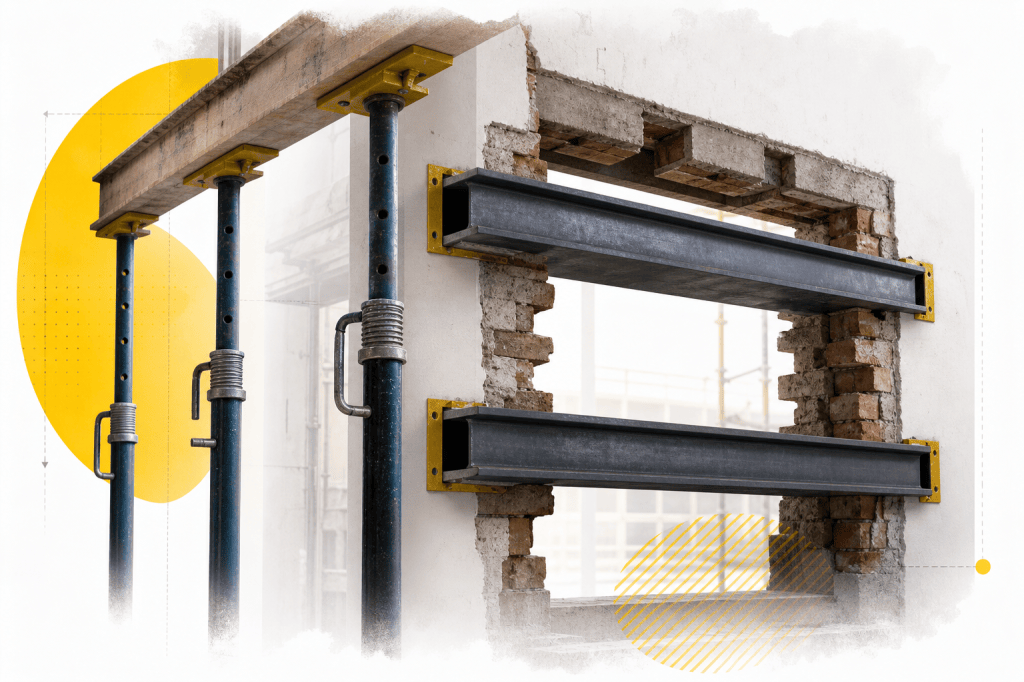
Propping uses temporary compression members — typically steel props, hydraulic jacks, or fabricated frames — to transfer loads away from a structural element that cannot carry them during a phase of construction or demolition. The prop takes the load while the permanent structure is modified, weakened, or replaced.
Common applications include:
- Supporting floor slabs and beams during basement construction
- Holding back retained walls or sheet piles during excavation
- Carrying loads across an opening before a new lintel or beam is installed
- Providing temporary support to a frame during phased demolition or refurbishment
The critical design questions for any propping scheme are load path, eccentricity, buckling length, and bearing capacity at each end. A prop that looks adequate in simple compression can fail through lateral instability if the effective length is not correctly assessed or if end conditions are assumed rather than designed.
Propping Loads and Load Cases
Propping design must account for the full range of loads the prop will see during its installed life — not just the primary design load. That includes construction traffic, accidental impact, temperature-induced expansion and contraction in steel props, and any dynamic effects from nearby plant.
Hydraulic props introduce additional considerations around pressure relief, lock-off procedures, and monitoring. The design pack should define the target pre-load, the permitted tolerance band, and the monitoring frequency. Without those parameters documented, the prop installation has no defined acceptance criteria and the permit-to-load cannot be properly controlled.
What Is Needling in Temporary Works?
Needling is a specific propping technique used to transfer the load of a wall or column through an opening that is being formed or enlarged. Steel needles — typically universal beams or fabricated sections — are threaded horizontally through the structure above the proposed opening and supported on props or dead shores on each side.
The needle carries the load of the masonry or structure above while the opening is formed below. Once the permanent lintel, beam, or frame is installed and has achieved adequate strength, the needles are removed in a controlled sequence.
Needling is common in:
- Underpinning and basement extension projects
- Retail and commercial refurbishment where large openings are being formed in load-bearing walls
- Residential extensions involving structural alterations to party walls or load-bearing masonry
- Historic building conservation where existing fabric must be retained while new structure is inserted
Why Needling Carries Higher Risk Than Standard Propping
The risk profile of needling is elevated for several reasons. The needle must be threaded through a wall that is already carrying load, which means the installation sequence directly affects load redistribution at every stage. Any movement during threading can cause cracking or partial failure in the masonry above.
Bearing conditions at each end of the needle are often uncertain. Masonry bearing capacity varies with mortar quality, brick type, and wall condition — none of which can be fully assessed from drawings alone. A competent design must include a site-specific bearing assessment and specify how the needle will be packed and wedged to achieve the assumed bearing.
Removal sequencing is equally important. Needles should not come out until the permanent works have been verified as capable of carrying the load. The design pack must define the hold point, the verification method, and who has authority to sign off removal.
Design Requirements for Propping and Needling
Under BS 5975:2024, all propping and needling schemes require a formal temporary works design, a design check appropriate to the category and complexity of the work, and a permit-to-load or permit-to-install before work starts.
What a Compliant Design Pack Contains
A complete propping or needling design pack should include:
- Design brief confirming scope, loads, geometry, and design assumptions
- Structural calculations covering load derivation, member sizing, buckling checks, and bearing capacity
- Sketches or drawings showing the arrangement, prop positions, needle locations, bearing details, and removal sequence
- Design risk assessment identifying hazards specific to the scheme and the control measures designed in
- RAMS review confirming that the method statement reflects the design intent and that the operatives' sequence matches the engineer's assumptions
- Inspection and Test Plan (ITP) defining hold points, witness points, and acceptance criteria
- Permit to load or permit to install with defined sign-off authority
The design check category matters. A complex propping scheme supporting multiple floors, or a needling operation in a building with uncertain load paths, will typically require a Cat 3 independent check. Simpler single-prop arrangements may be Cat 1 or Cat 2. The Temporary Works Coordinator is responsible for assigning the check category and ensuring it is carried out before the permit is issued.
BS 5975:2024 and the Designated Individual Obligation
The 2024 split of BS 5975 into Part 1 and Part 2 introduced more defined obligations around role assignment. The Designated Individual carries specific accountability for ensuring that temporary works procedures are in place and followed on the project. For propping and needling, the DI must be satisfied that the design has been checked to the appropriate category, that the permit system is active, and that the removal sequence is controlled.
No named DI and no functioning permit system means you are not compliant with BS 5975:2024 — regardless of how sound the engineering design is.
Common Failures in Propping and Needling Schemes
Most failures in propping and needling do not happen because the engineer got the calculation wrong. They happen because design assumptions were never communicated to site, the installation deviated from the drawing, or the removal sequence was not followed.
Specific failure patterns to watch for:
Assumed bearing that was never verified. The design specifies a bearing pad and a minimum bearing length. The operative installs the prop against bare masonry with no pad and a shorter bearing than specified. The calculation is fine; the installation is not.
Pre-load not applied or not checked. Hydraulic props are pre-loaded to a defined pressure to control movement. If the pre-load is not applied, the structure may move more than the design allows before the prop engages. If it is applied but never checked after initial installation, temperature changes or settlement can push the actual load outside the design range.
Needle removal before permanent works are verified. The programme is under pressure. The needle comes out before the new beam has been checked. This is the scenario that causes partial collapses in refurbishment projects.
RAMS that do not match the design. The method statement describes a generic propping sequence. The design requires a specific installation order. Nobody reconciled the two before the permit was issued.
A RAMS review that is genuinely independent of the method statement author — and that checks the sequence against the design drawings step by step — catches most of these before they become incidents.
Propping and Needling Under CDM 2015
CDM 2015 requires that temporary works designs are produced by a competent designer and that design risk is managed through the pre-construction phase. For propping and needling, the principal contractor must ensure that:
- The temporary works designer has been appointed with a clear brief
- The design has been checked before work starts
- Residual risks are communicated to those carrying out the work
- The construction phase plan reflects the temporary works sequence
Where a subcontractor is carrying out the propping or needling, the principal contractor retains responsibility for ensuring the temporary works design is in place and checked. "The sub said they'd sort it" is not a defensible position at an HSE investigation.
Getting Design Support for Propping and Needling
If you have a propping or needling scheme on a live or mobilising project and no in-house temporary works engineer available, remote design support is a practical option. Temporary Works Consulting & Design Ltd provides propping and needling design packs delivered remotely — covering calculations, drawings, design risk assessments, and RAMS review — with fixed-price quotes agreed upfront before any work starts.
The service covers Cat 0 to Cat 3 design check coordination, BS 5975:2024 compliance support including permit and register setup, and one-to-one mentoring for coordinators and engineers working through complex schemes for the first time. Quotes are available via the quote form or WhatsApp, and no site visit is required to begin the design process.
Key Questions to Ask Before Work Starts
Before any propping or needling scheme goes to permit, run through this checklist:
- Has the design brief been formally issued and accepted by the designer?
- Do the calculations cover all load cases, including construction loads and temperature effects?
- Has the design been checked to the correct category and has the checker signed off?
- Does the RAMS match the design drawings, step by step?
- Are the hold points in the ITP defined and understood by the site team?
- Is there a named person with authority to issue and close the permit?
- Is the removal sequence documented and does it include a verification hold point for the permanent works?
If any of these are missing, the permit should not be issued.
FAQs
What is the difference between propping and needling?
Propping is a general term for using temporary compression members to transfer structural loads during construction or demolition. Needling is a specific type of propping where steel beams are threaded horizontally through a wall or structure to carry loads above an opening being formed or enlarged. All needling involves propping, but not all propping is needling.
When does a propping scheme need a Cat 3 independent check?
BS 5975:2024 requires the Temporary Works Coordinator to assign a check category based on complexity and consequence. Cat 3 is typically required where failure would have serious consequences, where the load path is complex or uncertain, or where multiple floors or structural elements are being supported simultaneously. The TW Coordinator makes the final call, but the designer should flag any scheme where they consider Cat 3 appropriate.
Can I use a standard design for propping or needling?
Standard designs are available for common propping configurations, but they come with defined scope limits. If your site conditions, loads, or geometry fall outside those limits, a bespoke design is required. Using a standard design outside its stated scope is not compliant and does not transfer liability to the design author.
What should a RAMS review for propping cover?
A RAMS review should check that the method statement sequence matches the design drawings step by step, that all pre-load requirements are captured, that hold points and inspection requirements are included, and that the removal sequence reflects the design intent. A generic RAMS that has not been reconciled against the specific design drawings is not adequate.
Who is responsible for temporary works compliance on a CDM project?
The principal contractor is responsible for ensuring that temporary works designs are in place, checked, and communicated to those carrying out the work. The Temporary Works Coordinator manages the day-to-day process. Under BS 5975:2024, the Designated Individual holds specific accountability for ensuring that procedures are followed across the project.
What happens if a needle is removed before the permanent works are verified?
Removing a needle before the permanent structure has been verified as capable of carrying the load removes the only element supporting that load. If the permanent works are not yet adequate, the structure above the opening has nothing holding it up. This is a direct cause of partial collapse in refurbishment projects and carries serious legal and safety consequences.
How quickly can I get a propping or needling design produced remotely?
Turnaround depends on the complexity of the scheme and how complete the information is at the point of instruction. Remote delivery means the process can begin as soon as the brief is issued, without waiting for a site visit. Fixed-price quotes are available on request via the quote form or WhatsApp at Temporary Works Consulting & Design Ltd.
Conclusion
Propping and needling are not areas where good intentions substitute for documented engineering. The design must be right, the check must be carried out, the RAMS must match the drawings, and the permit must be controlled. If any part of that chain is missing, the scheme is not compliant and the risk sits with the principal contractor.
If you have a scheme that needs a design pack, a RAMS review, or BS 5975:2024 compliance support, get a fixed-price quote before the programme forces a decision. Remote delivery means there is no reason to start work without the paperwork in place.
 dmtecs-acvsl
Leave a comment