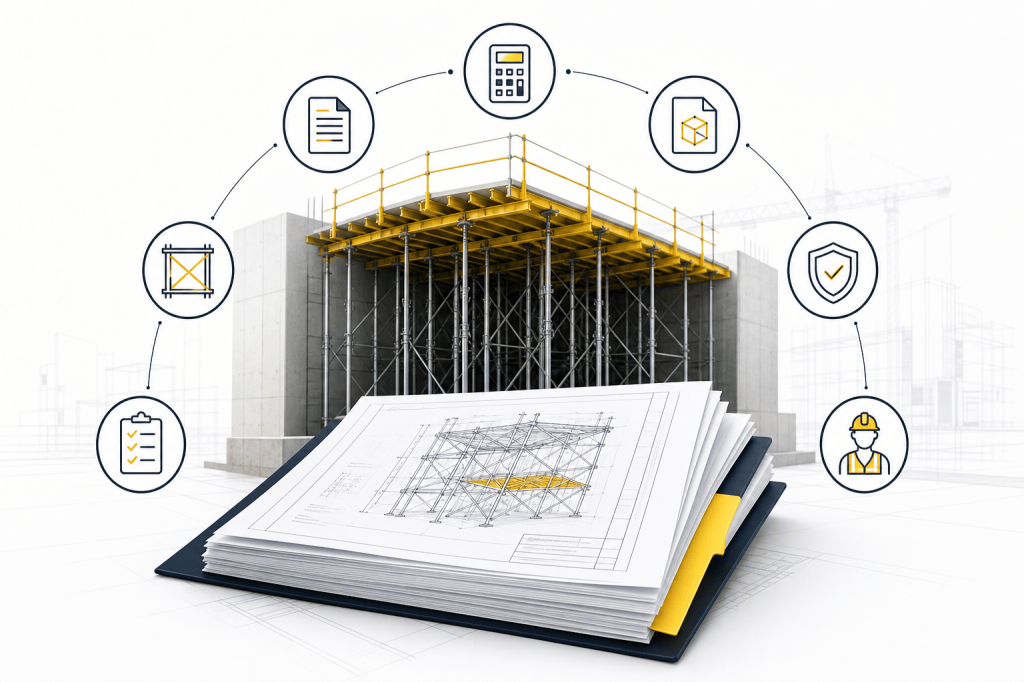
- What Is a Temporary Works Design Pack?
- Why BS 5975:2024 Matters for Your Pack
- What a Complete Temporary Works Design Pack Must Include
- Common Gaps That Get Packs Rejected
- Who Is Responsible for the Design Pack?
- What to Do If You Don't Have a Pack in Place
- FAQs
If you've been asked to produce a temporary works design pack, or you're about to commission one, the question of what it actually needs to contain is more important than it might first appear. A poorly assembled pack can hold up permits, fail a Cat 3 check, or leave your site team without the information they need to work safely. A well-assembled one keeps the programme moving and gives everyone — from the site engineer to the principal contractor — a clear, auditable record of what was designed, checked, and approved.
This guide explains what a temporary works design pack is, what it must include under BS 5975:2024, and what happens when key elements are missing.
What Is a Temporary Works Design Pack?
A temporary works design pack is the full set of documents that defines, justifies, and controls a temporary works scheme. It covers everything from the initial brief through to the signed-off drawings and permits that allow work to proceed on site.
Temporary works — excavation support, falsework, propping, scaffolding, crane mats, cofferdams, and similar structures — are by definition not permanent. But that doesn't make them any less critical. They carry real loads, interact with real ground conditions, and put real people at risk if they fail. The design pack is the documented evidence that the scheme has been properly thought through.
Under BS 5975:2024, the standard that governs temporary works procedures in the UK, a design pack is not optional. It is a requirement for any temporary works that fall within the standard's scope, and it must be in place before the works begin.
Why BS 5975:2024 Matters for Your Pack
BS 5975 has been the backbone of UK temporary works management for decades. The 2024 revision tightened several requirements around documentation, roles, and the checking process. If your pack was assembled to an older version of the standard, it may not satisfy what auditors, principal contractors, or insurers now expect to see.
The standard sets out the roles of the Temporary Works Coordinator (TWC) and Temporary Works Supervisor (TWS), defines the categories of design check (Cat 0 through Cat 3), and specifies what a design brief, design, and permit to load or strike must contain. Your design pack needs to reflect all of this.
What a Complete Temporary Works Design Pack Must Include
The exact contents will vary depending on the nature of the scheme, but the following elements are standard for most temporary works operations in 2026.
1. The Design Brief
This is where everything starts. The design brief sets out what the temporary works need to achieve, the constraints the designer must work within, and any assumptions about ground conditions, loads, or programme sequence.
A good brief will include:
- The purpose and scope of the temporary works
- Site-specific constraints (proximity to services, adjacent structures, ground investigation data)
- Loads to be carried, including construction loads and any dynamic effects
- Programme requirements and the sequence of construction
- Any interface with permanent works design
- Identification of the designer, TWC, and checking category required
If the brief is vague or incomplete, the design that follows it will be too. Problems at this stage tend to surface at the worst possible moment — when the design is being checked or when the permit is being issued.
2. Structural Calculations
The calculations are the technical core of the pack. They demonstrate that the proposed scheme can carry the required loads with adequate factors of safety, and they record the assumptions the designer made in reaching that conclusion.
Calculations should cover:
- Loading analysis (dead loads, live loads, wind, water pressure where relevant)
- Member sizing and capacity checks
- Ground bearing pressure assessments where applicable (referenced to BR 470 for working platforms and crane mats)
- Stability checks, including overturning and sliding where relevant
- Connection and fixity assumptions
The calculations must be traceable. If a checker or auditor picks up the pack six months later, they need to be able to follow the logic from brief to conclusion without having to ask the designer for clarification.
3. Sketches and Drawings
Calculations alone are not enough. The design pack must include drawings that translate the structural analysis into something the site team can actually build from.
These typically include:
- General arrangement drawings showing the overall scheme
- Detail drawings for connections, props, anchors, or other critical elements
- Section drawings where geometry is complex
- Any setting-out information the site team needs
Drawings should be clearly titled, dimensioned, and revision-controlled. A drawing without a revision number or issue date is a risk — you can't be certain the site is working from the current version.
4. Design Assumptions and Limitations
Every design is based on assumptions. The pack must state them clearly so that the TWC and site team know when those assumptions no longer hold.
Common examples include:
- Maximum surcharge loads within a specified distance of an excavation
- Groundwater levels assumed in the design
- Maximum imposed loads on a working platform
- Sequence constraints — for example, a prop that must remain in place until a specific stage of the permanent works is complete
If site conditions change and the assumptions are no longer valid, the design needs to be revisited. The pack is what tells you that.
5. Method Statement and RAMS
The design pack should be accompanied by, or reference, a method statement that describes how the temporary works will be installed, used, and removed. The Risk Assessment and Method Statement (RAMS) must be consistent with the design — loads, sequences, and constraints in the RAMS should match what the designer has assumed.
A common problem is a RAMS that has been written independently of the design, with different load assumptions or a different construction sequence. This creates a compliance gap that a competent TWC or checking engineer will flag immediately.
6. The Design Check Record
BS 5975:2024 requires that temporary works designs are checked, and the check category determines who can carry out that check and what it must cover.
- Cat 0: A check by the designer themselves — suitable only for very straightforward, low-risk schemes
- Cat 1: An independent check by a competent person within the same organisation
- Cat 2: An independent check by a competent person from a different organisation
- Cat 3: A detailed, fully independent check — required for high-risk or complex schemes
The design pack must include a record of the check: who carried it out, what category it was, what was reviewed, and any comments raised and resolved. A design that has been checked but has no record of that check is, from a compliance standpoint, the same as a design that hasn't been checked at all.
7. Permit to Load, Use, or Strike
The permit is the final control document. It confirms that the temporary works have been installed in accordance with the design, that the design assumptions are still valid, and that the works can proceed.
Depending on the scheme, you may need:
- A permit to load (for falsework, propping, or working platforms)
- A permit to strike (for falsework removal or de-propping)
- A permit to excavate (for excavation support schemes)
The permit should reference the design pack, confirm who has authorised it, and record any conditions that apply. It is the TWC's responsibility to issue it, and it should not be issued until all elements of the pack are in place and the installation has been inspected.
Common Gaps That Get Packs Rejected
Even experienced teams can produce packs with gaps that cause delays. The most frequent problems are:
- Missing or incomplete design brief — the designer has worked from verbal instructions rather than a documented brief
- Calculations that don't match the drawings — member sizes or spans in the drawings differ from what was calculated
- RAMS written independently of the design — load assumptions or sequences are inconsistent
- No check record — the design has been checked but there is no written record of it
- Drawings without revision control — the site team cannot confirm they are working from the current issue
- Permits not issued before work starts — the design pack is complete, but the permit process has been bypassed under programme pressure
Any of these can result in a permit being refused, a notifiable incident becoming a compliance failure, or a design being rejected during a Cat 3 check.
Who Is Responsible for the Design Pack?
Responsibility sits with several parties, and BS 5975:2024 is clear about how they interact.
The Temporary Works Designer produces the calculations, drawings, and design documentation. They are responsible for the technical content of the pack.
The Temporary Works Coordinator manages the overall process — from brief to permit. They ensure the pack is complete, the check has been carried out at the right category, and the permit is issued at the right time.
The Principal Contractor has overall responsibility for ensuring that the TW management system is in place and that the standard is being followed on their project.
Where contractors don't have in-house design resource or a competent TWC, they need external support. That's where a specialist like Temporary Works Consulting & Design Ltd comes in — providing the design, the checking coordination, and the compliance support as a single accountable service.
What to Do If You Don’t Have a Pack in Place
If you have an excavation, propping, or scaffold operation coming up and no design pack in place, the first step is to get a design brief together. Even a rough brief — scope, loads, programme, constraints — gives a designer enough to scope the work and give you a realistic turnaround time.
Don't wait until the day before the permit is needed. A complete pack, including calculations, drawings, RAMS review, and check coordination, takes time to produce properly. Rushing it creates exactly the kind of gaps listed above.
If you're not sure what category of check your scheme requires, or whether your existing pack is complete, a short scoping conversation with a qualified designer will usually answer both questions quickly.
FAQs
What is a temporary works design pack?
A temporary works design pack is the full set of documents required to define, justify, and control a temporary works scheme. It typically includes a design brief, structural calculations, drawings, design assumptions, a RAMS, a design check record, and the relevant permits.
Is a temporary works design pack required by law?
BS 5975:2024 is a British Standard, not legislation, but it is widely referenced in contracts, CDM regulations guidance, and insurance requirements. In practice, most principal contractors and insurers require compliance with it, making a complete design pack effectively mandatory for notifiable or complex temporary works.
What is the difference between a Cat 2 and Cat 3 check?
A Cat 2 check is an independent check carried out by a competent person from a different organisation to the designer. A Cat 3 check is a more detailed, fully independent check required for high-risk or complex schemes. Both must be documented in the design pack.
Who can produce a temporary works design pack?
The design must be produced by a competent temporary works designer — typically a chartered engineer with relevant experience. The design pack should also be coordinated by a qualified TWC who manages the process from brief to permit.
How long does it take to produce a temporary works design pack?
It depends on the complexity of the scheme. A straightforward prop or working platform design might be turned around in a few days. A complex excavation support or falsework scheme could take several weeks, particularly if ground investigation data is needed or a Cat 3 check is required.
What happens if work starts without a complete design pack?
Starting work without a complete, checked, and permitted design pack is a serious compliance failure. It can result in enforcement action under CDM regulations, invalidate your insurance, and — most importantly — put people at risk if the temporary works are not fit for purpose.
Can I get a standard design pack rather than a bespoke one?
For some common temporary works types, standard designs are available and can be appropriate where site conditions match the design assumptions exactly. For anything site-specific, a bespoke design is needed. A competent designer can advise which route is appropriate for your scheme.
Getting a temporary works design pack right is not complicated once you know what it needs to contain. The standard is clear, the roles are defined, and the process is well established. What causes delays and compliance failures is usually not ignorance of the requirements — it's leaving things too late or assembling the pack without a single accountable designer managing the process end to end.
If you need a complete, BS 5975:2024-compliant design pack for an upcoming operation, you can find out more at temporaryworksconsulting.com.
 dmtecs-acvsl
Leave a comment